First satellites of countries
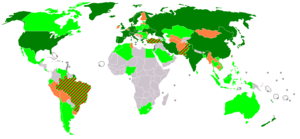
| Country | Year of first launch | First satellite | Operational payloads in orbit as of April 2020 |
|---|---|---|---|
| Soviet Union (Russia) |
1957 (1992) |
Sputnik 1 (Kosmos 2175) |
1524 |
| United States | 1958 | Explorer 1 | 1914 |
| China | 1970 | Dong Fang Hong I | 391 |
| Japan | 1970 | Ohsumi | 181 |
| India | 1975 | Aryabhata | 96 |
| France | 1965 | Astérix | 73 |
| Germany | 1969 | Azur | 67 |
| Canada | 1962 | Alouette 1 | 54 |
| United Kingdom | 1962 | Ariel 1 | 54 |
| Italy | 1964 | San Marco 1 | 29 |
| South Korea | 1992 | Kitsat A | 23 |
| Spain | 1974 | Intasat | 27 |
| Australia | 1967 | WRESAT | 22 |
| Brazil | 1985 | Brasilsat-A1 | 21 |
| Argentina | 1990 | Lusat | 20 |
| Israel | 1988 | Ofeq 1 | 20 |
| Indonesia | 1976 | Palapa A1 | 18 |
| Turkey | 1994 | Turksat 1B | 13 |
| Saudi Arabia | 1985 | Arabsat-1A | 15 |
| Mexico | 1985 | Morelos 1 | 13 |
| Sweden | 1986 | Viking | 11 |
| Singapore | 1998 | ST-1 | 11 |
| Netherlands | 1974 | ANS | 8 |
| Czechoslovakia | 1978 | Magion 1 | 2 |
| Bulgaria | 1981 | Intercosmos Bulgaria 1300 | 2 |
| Luxembourg | 1988 | Astra 1A | 4 |
| Pakistan | 1962 | Rehbar-1 | 6 |
| Portugal | 1993 | PoSAT-1 | 2 |
| Thailand | 1993 | Thaicom 1 | 10 |
| Czech Republic | 1995 | Magion 4 | 3 |
| Ukraine | 1995 | Sich-1 | 6 |
| Malaysia | 1996 | MEASAT | 7 |
| Norway | 1997 | Thor 2 | 9 |
| Philippines | 1997 | Mabuhay 1 | 2 |
| Egypt | 1998 | Nilesat 101 | 5 |
| Chile | 1998 | FASat-Bravo | 3 |
| Republic of China (ROC) | 1999 | Formosat-1 | 15 |
| Denmark | 1999 | Ørsted | 9 |
| South Africa | 1999 | SUNSAT | 6 |
| United Arab Emirates | 2000 | Thuraya 1 | 9 |
| Morocco | 2001 | Maroc-Tubsat | 1 |
| Belgium | 2001 | PROBA-1 | 0 |
| Tonga | 2002 | Esiafi 1 (former Comstar D4) | 0 |
| Algeria | 2002 | Alsat 1 | 6 |
| Greece | 2003 | Hellas Sat 2 | 4 |
| Cyprus | 2003 | Hellas Sat 2 | 0 |
| Nigeria | 2003 | Nigeriasat 1 | 6 |
| Iran | 2005 | Sina-1 | 1 |
| Kazakhstan | 2006 | KazSat 1 | 6 |
| Colombia | 2007 | Libertad 1 | 0 |
| Mauritius | 2007 | Rascom-QAF 1 | 0 |
| Vietnam | 2008 | Vinasat-1 | 3 |
| Venezuela | 2008 | Venesat-1 | 3 |
| Switzerland | 2009 | SwissCube-1 | 0 |
| Isle of Man | 2011 | ViaSat-1 | 1 |
| Poland | 2012 | PW-Sat | 4 |
| Hungary | 2012 | MaSat-1 | 0 |
| Sri Lanka | 2012 | SupremeSAT-I | 1 |
| Romania | 2012 | Goliat | 0 |
| Belarus | 2012 | BKA (BelKA-2) | 2 |
| North Korea | 2012 | Kwangmyŏngsŏng-3 Unit 2 | 2 |
| Azerbaijan | 2013 | Azerspace | 1 |
| Austria | 2013 | TUGSAT-1/UniBRITE | 0 |
| Bermuda | 2013 | Bermudasat 1 (former EchoStar VI) | 0 |
| Ecuador | 2013 | NEE-01 Pegaso | 2 |
| Estonia | 2013 | ESTCube-1 | 1 |
| Jersey | 2013 | O3b-1, −2, −3, −4 | 0 |
| Qatar | 2013 | Es'hailSat1 | 0 |
| Peru | 2013 | PUCPSAT-1 | 2 |
| Bolivia | 2013 | TKSat-1 | 1 |
| Lithuania | 2014 | LituanicaSAT-1 and LitSat-1 | 1 |
| Uruguay | 2014 | Antelsat | 1 |
| Iraq | 2014 | Tigrisat | 0 |
| Turkmenistan | 2015 | TurkmenAlem52E/MonacoSAT | 1 |
| Laos | 2015 | Laosat-1 | 1 |
| Finland | 2017 | Aalto-2 | 1 |
| Bangladesh | 2017 | BRAC Onnesha | 2 |
| Ghana | 2017 | GhanaSat-1 | 1 |
| Mongolia | 2017 | Mazaalai | 1 |
| Latvia | 2017 | Venta-1 | 1 |
| Slovakia | 2017 | skCUBE | 1 |
| Asgardia | 2017 | Asgardia-1 | 1 |
| Angola | 2017 | AngoSat 1 | 1 |
| New Zealand | 2018 | Humanity Star | 1 |
| Bangladesh | 2018 | Bangabandhu-1 | 1 |
| Costa Rica | 2018 | Proyecto Irazú | 1 |
| Kenya | 2018 | 1KUNS-PF | 1 |
| Bhutan | 2018 | BHUTAN-1 | 1 |
| Jordan | 2018 | JY1-SAT | 1 |
| Nepal | 2019 | NepaliSat-1 | 1 |
| Rwanda | 2019 | RWASat-1 | 1 |
| Sudan | 2019 | SRSS-1 | 1 |
| Ethiopia | 2019 | ETRSS-1 | 1 |
| Guatemala | 2020 | Quetzal-1 | 1 |
| Slovenia | 2020 | TRISAT/NEMO-HD | 2 |
| Monaco | 2020 | OSM-1 Cicero | 1 |
While Canada was the third country to build a satellite which was launched into space, it was launched aboard an American rocket from an American spaceport. The same goes for Australia, who launched first satellite involved a donated U.S. Redstone rocket and American support staff as well as a joint launch facility with the United Kingdom. The first Italian satellite San Marco 1 launched on 15 December 1964 on a U.S. Scout rocket from Wallops Island (Virginia, United States) with an Italian launch team trained by NASA. By similar occasions, almost all further first national satellites was launched by foreign rockets.
Attempted first satellitesedit
- United States tried unsuccessfully to launch its first satellite in 1957; they were successful in 1958.
- China tried unsuccessfully to launch its first satellite in 1969; they were successful in 1970.
- Iraq under Saddam Hussein fulfilled in 1989 an unconfirmed launch of warhead on orbit by developed Iraqi vehicle that intended to put later the 75 kg first national satellite Al-Ta’ir, also developed.
- Chile tried unsuccessfully in 1995 to launch its first satellite FASat-Alfa by foreign rocket; in 1998 they were successful.†
- North Korea has tried in 1998, 2009, 2012 to launch satellites, first successful launch on 12 December 2012.
- Libya since 1996 developed its own national Libsat satellite project with the goal of providing telecommunication and remote sensing services that was postponed after the fall of Gaddafi.
- Belarus tried unsuccessfully in 2006 to launch its first satellite BelKA by foreign rocket.†
†-note: Both Chile and Belarus used Russian companies as principal contractors to build their satellites, they used Russian-Ukrainian manufactured rockets and launched either from Russia or Kazakhstan.
Planned first satellitesedit
- Afghanistan announced in April 2012 that it is planning to launch its first communications satellite to the orbital slot it has been awarded. The satellite Afghansat 1 was expected to be obtained by a Eutelsat commercial company in 2014.
- Armenia in 2012 founded Armcosmos company and announced an intention to have the first telecommunication satellite ArmSat. The investments estimates as $250 million and country selecting the contractor for building within 4 years the satellite amongst Russia, China and Canada
- Cambodia's Royal Group plans to purchase for $250–350 million and launch in the beginning of 2013 the telecommunication satellite.
- Cayman Islands's Global IP Cayman private company plans to launch GiSAT-1 geostationary communications satellite in 2018.
- Democratic Republic of Congo ordered at November 2012 in China (Academy of Space Technology (CAST) and Great Wall Industry Corporation (CGWIC)) the first telecommunication satellite CongoSat-1 which will be built on DFH-4 satellite bus platform and will be launched in China till the end of 2015.
- Croatia has a goal to construct a satellite by 2013–2014. Launch into Earth orbit would be done by a foreign provider.
- Ireland's team of Dublin Institute of Technology intends to launch the first Irish satellite within European University program CubeSat QB50.
- Republic of Moldova's first remote sensing satellite plans to start in 2013 by Space centre at national Technical University.
- Myanmar plans to purchase for $200 million their own telecommunication satellite.
- Nicaragua ordered for $254 million at November 2013 in China the first telecommunication satellite Nicasat-1 (to be built at DFH-4 satellite bus platform by CAST and CGWIC), that planning to launch in China at 2016.
- Paraguay under new Agencia Espacial del Paraguay –- AEP airspace agency plans first Eart observation satellite.
- Serbia's first satellite Tesla-1 was designed, developed and assembled by nongovernmental organisations in 2009 but still remains unlaunched.
- Sri Lanka has a goal to construct two satellites beside of rent the national SupremeSAT payload in Chinese satellites. Sri Lankan Telecommunications Regulatory Commission has signed an agreement with Surrey Satellite Technology Ltd to get relevant help and resources. Launch into Earth orbit would be done by a foreign provider.
- Syrian Space Research Center developing CubeSat-like small first national satellite since 2008.
- Tunisia is developing its first satellite, ERPSat01. Consisting of a CubeSat of 1 kg mass, it will be developed by the Sfax School of Engineering. ERPSat satellite is planned to be launched into orbit in 2013.
- Uzbekistan's State Space Research Agency (UzbekCosmos) announced in 2001 about intention of launch in 2002 first remote sensing satellite. Later in 2004 was stated that two satellites (remote sensing and telecommunication) will be built by Russia for $60–70 million each


Comments
Post a Comment