Launch-capable countries
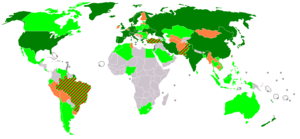
This list includes countries with an independent capability to place satellites in orbit, including production of the necessary launch vehicle. Note: many more countries have the capability to design and build satellites but are unable to launch them, instead relying on foreign launch services. This list does not consider those numerous countries, but only lists those capable of launching satellites indigenously, and the date this capability was first demonstrated. The list does not include the European Space Agency, a multi-national state organization, nor private consortiums.
| Order | Country | Date of first launch | Rocket | Satellite(s) |
|---|---|---|---|---|
| 1 | Soviet Union | 4 October 1957 | Sputnik-PS | Sputnik 1 |
| 2 | United States | 1 February 1958 | Juno I | Explorer 1 |
| 3 | France | 26 November 1965 | Diamant-A | Astérix |
| 4 | Japan | 11 February 1970 | Lambda-4S | Ohsumi |
| 5 | China | 24 April 1970 | Long March 1 | Dong Fang Hong I |
| 6 | United Kingdom | 28 October 1971 | Black Arrow | Prospero |
| 7 | India | 18 July 1980 | SLV | Rohini D1 |
| 8 | Israel | 19 September 1988 | Shavit | Ofeq 1 |
| – | Russia | 21 January 1992 | Soyuz-U | Kosmos 2175 |
| – | Ukraine | 13 July 1992 | Tsyklon-3 | Strela |
| 9 | Iran | 2 February 2009 | Safir-1 | Omid |
| 10 | North Korea | 12 December 2012 | Unha-3 | Kwangmyŏngsŏng-3 Unit 2 |
| 11 | South Korea | 30 January 2013 | Naro-1 | STSAT-2C |
| 12 | New Zealand | 12 November 2018 | Electron | CubeSat |
Attempted first launchesedit
- The United States tried in 1957 to launch the first satellite using its own launcher before successfully completing a launch in 1958.
- Japan tried four times in 1966–1969 to launch a satellite with its own launcher before successfully completing a launch in 1970.
- China tried in 1969 to launch the first satellite using its own launcher before successfully completing a launch in 1970.
- India, after launching its first national satellite using a foreign launcher in 1975, tried in 1979 to launch the first satellite using its own launcher before succeeding in 1980.
- Iraq have claimed an orbital launch of a warhead in 1989, but this claim was later disproved.
- Brazil, after launching its first national satellite using a foreign launcher in 1985, tried to launch a satellite using its own VLS 1 launcher three times in 1997, 1999, and 2003, but all attempts were unsuccessful.
- North Korea claimed a launch of Kwangmyŏngsŏng-1 and Kwangmyŏngsŏng-2 satellites in 1998 and 2009, but U.S., Russian and other officials and weapons experts later reported that the rockets failed to send a satellite into orbit, if that was the goal. The United States, Japan and South Korea believe this was actually a ballistic missile test, which was a claim also made after North Korea's 1998 satellite launch, and later rejected. The first (April 2012) launch of Kwangmyŏngsŏng-3 was unsuccessful, a fact publicly recognized by the DPRK. However, the December 2012 launch of the "second version" of Kwangmyŏngsŏng-3 was successful, putting the DPRK's first confirmed satellite into orbit.
- South Korea (Korea Aerospace Research Institute), after launching their first national satellite by foreign launcher in 1992, unsuccessfully tried to launch its own launcher, the KSLV (Naro)-1, (created with the assistance of Russia) in 2009 and 2010 until success was achieved in 2013 by Naro-3.
- The First European multi-national state organization ELDO tried to make the orbital launches at Europa I and Europa II rockets in 1968–1970 and 1971 but stopped operation after failures.
Other notesedit
- ^ Russia and Ukraine were parts of the Soviet Union and thus inherited their launch capability without the need to develop it indigenously. Through the Soviet Union they are also on the number one position in this list of accomplishments.
- France, the United Kingdom, and Ukraine launched their first satellites by own launchers from foreign spaceports.
- Some countries such as South Africa, Spain, Italy, Germany, Canada, Australia, Argentina, Egypt and private companies such as OTRAG, have developed their own launchers, but have not had a successful launch.
- Only twelve, countries from the list below (USSR, USA, France, Japan, China, UK, India, Russia, Ukraine, Israel, Iran and North Korea) and one regional organization (the European Space Agency, ESA) have independently launched satellites on their own indigenously developed launch vehicles.
- Several other countries, including Brazil, Argentina, Pakistan, Romania, Taiwan, Indonesia, Australia, Malaysia, Turkey and Switzerland are at various stages of development of their own small-scale launcher capabilities.
Launch capable private entitiesedit
Orbital Sciences Corporation launched a satellite into orbit on the Pegasus in 1990. SpaceX launched a satellite into orbit on the Falcon 1 in 2008. Rocket Lab launched three cubesats into orbit on the Electron in 2018.

Comments
Post a Comment